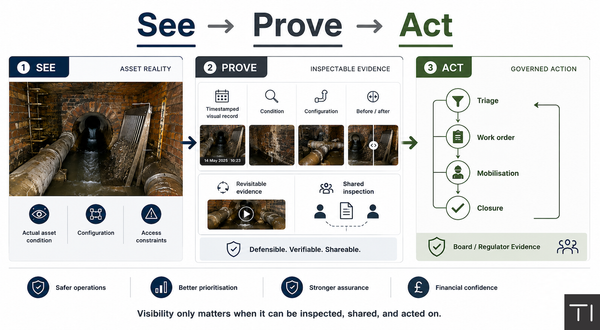
From Seeing to Fixing: The Two Gaps Water Companies Can No Longer Carry
Water companies face two connected gaps: seeing what is really inside their assets, and turning what they find into governed, prioritised action.

Water companies face two connected gaps: seeing what is really inside their assets, and turning what they find into governed, prioritised action.
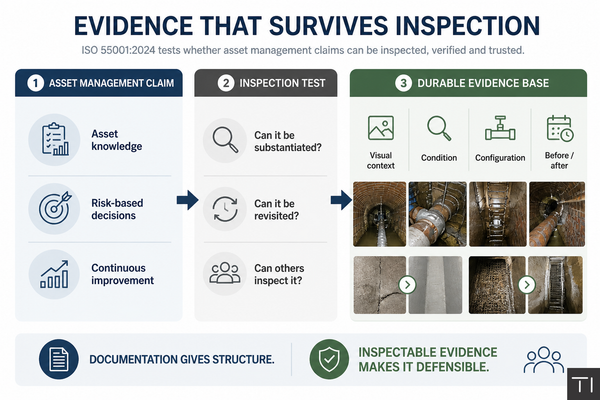
ISO 55001 has always been about discipline rather than technology. It sets out what a good asset management system looks like: objectives aligned to outcomes, decisions grounded in risk, and processes that can be demonstrated and improved over time. For many organisations, certification has meant documenting those elements clearly and
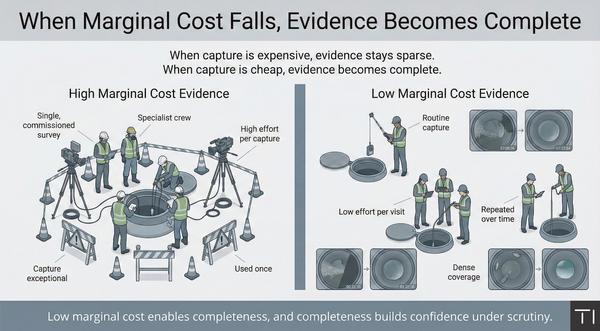
In regulated infrastructure, the conversation about evidence quality often starts with cost. Surveys are expensive. Specialist inspections require coordination. High-end systems come with procurement, training, and support overhead. As a result, evidence gathering is treated as something to be minimised, carefully justified, and used sparingly. This framing misses what
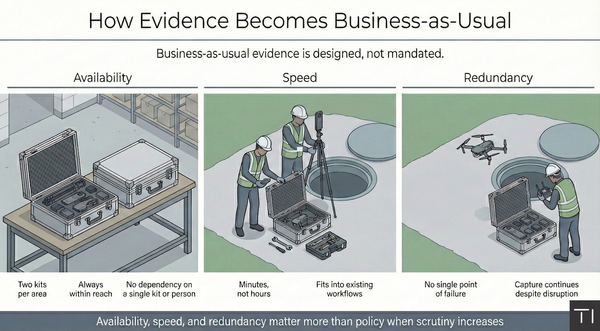
In many organisations, evidence programmes fail not because of policy gaps, but because of friction. Expectations are set, procedures are written, and capture is encouraged, yet evidence remains sporadic. Under scrutiny, the absence of evidence is explained as an exception. Over time, those exceptions accumulate. What determines whether evidence becomes
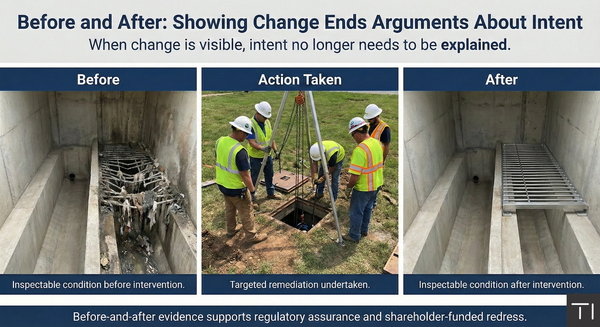
In regulatory and assurance contexts, many disputes do not arise because action was not taken, but because it cannot be shown clearly what changed as a result. Intent is asserted, effort is described, and plans are documented, yet confidence remains elusive. Under increasing scrutiny, this pattern has become a liability.

In regulated infrastructure, the tools used to gather evidence often attract more attention than the evidence itself. There is a persistent assumption that “enterprise-grade” capability must be complex, specialised, and tightly controlled. In practice, this assumption frequently produces systems that are impressive on paper and fragile in the field.
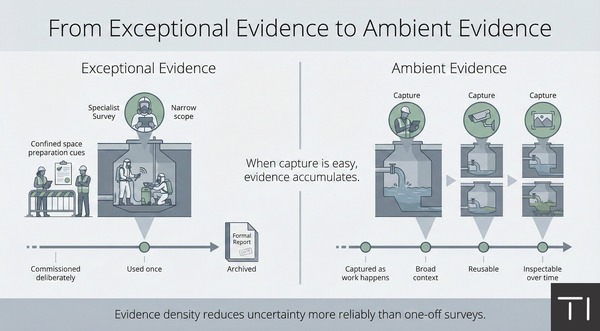
In much of the UK water sector, evidence is still treated as something exceptional. It is commissioned deliberately, planned in advance, and gathered for a specific purpose. Surveys are scheduled. Specialists are mobilised. Access is arranged. Evidence is produced, used, and then archived. This model made sense when capture was
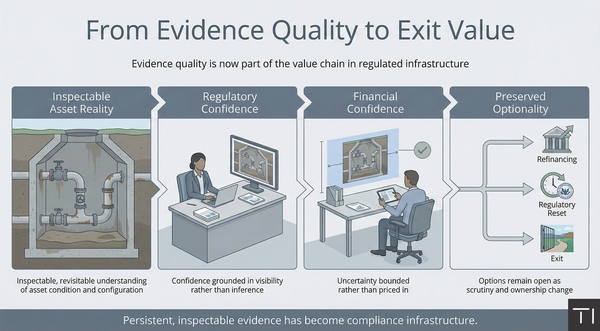
Across regulated infrastructure, exit value is rarely created at the moment of sale. It is accumulated, quietly, through years of decisions that reduce uncertainty, preserve confidence, and keep future options open. In the UK water sector, that accumulation increasingly depends on whether asset understanding can survive scrutiny by parties who
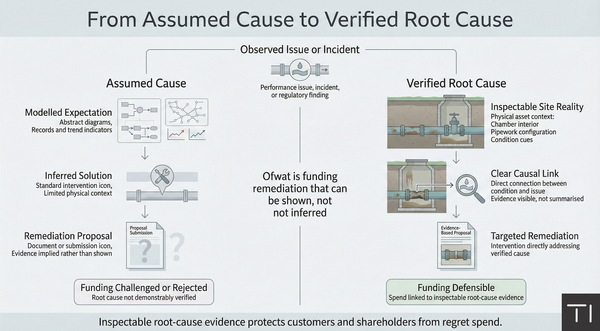
Ofwat’s recent decisions to reject or challenge remediation funding requests have surprised some in the sector. From the utility perspective, proposed interventions often feel reasonable, urgent, and well intentioned. Assets are ageing, performance is under pressure, and remediation appears necessary. From the regulator’s perspective, however, a different question
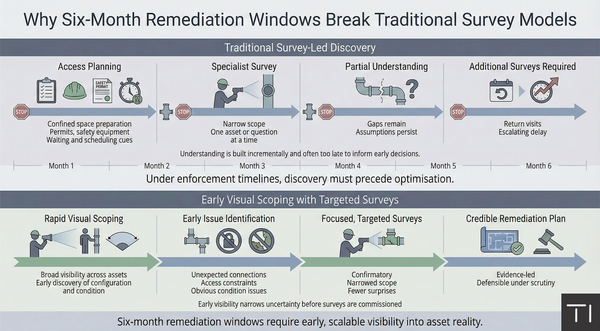
Ofwat’s recent enforcement actions have changed the tempo of remediation. Water companies are now being required to produce credible remediation plans for wastewater treatment works and networks within compressed timeframes, often measured in months rather than years. Six-month windows are becoming common. This shift exposes a mismatch between

Ofwat’s recent enforcement activity has placed boards firmly in scope. The issue is not whether boards received reports, dashboards, or assurances. It is whether they had genuine line of sight into asset condition and performance, sufficient to challenge assumptions and satisfy themselves that risks were understood and controlled. Performance
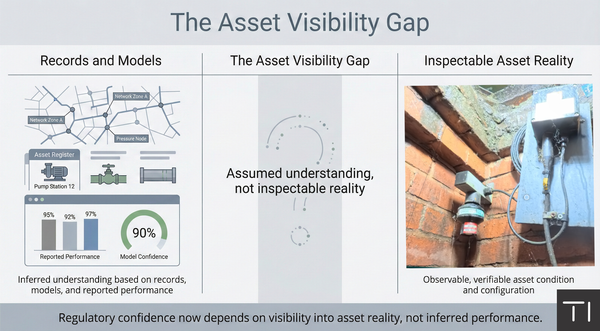
Across the UK water sector, enforcement activity has converged on a single underlying failure. Companies have not lacked intent, investment, or analytical capability. What they have lacked is reliable, inspectable visibility into the condition and configuration of their assets. Ofwat’s recent actions make clear that this is no longer
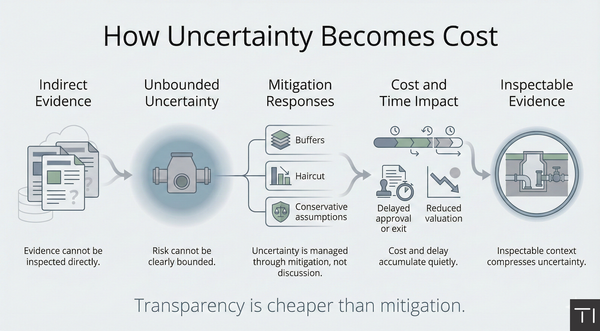
In infrastructure ownership and finance, uncertainty is rarely debated at length. It is priced. When evidence is incomplete, indirect, or difficult to inspect, the response is not extended discussion but adjustment. Buffers increase, assumptions become more conservative, and value is discounted to protect against what cannot be clearly seen. This
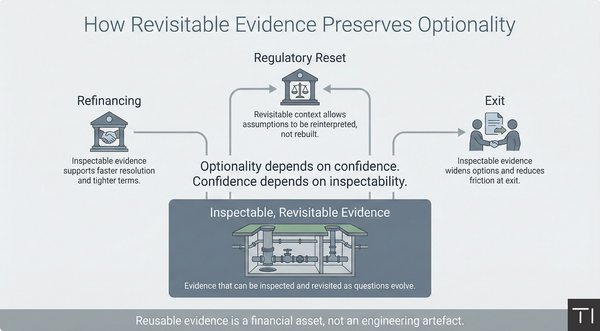
In infrastructure ownership, optionality is often discussed in abstract terms. The ability to refinance, restructure, exit, or adapt to regulatory change is treated as a function of market conditions and timing. In practice, optionality depends on something more prosaic: confidence. And confidence depends on whether the reality of the asset
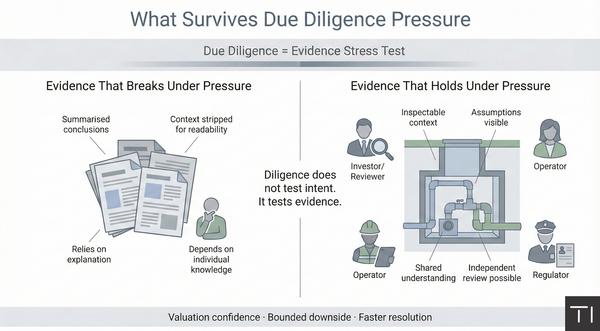
Due diligence is where comfortable assumptions meet pressure. It is not designed to validate what is already believed, but to expose what might go wrong. In that sense, it functions as a stress test for evidence. What survives scrutiny under time constraint, adversarial questioning, and third-party review is treated

In infrastructure valuation, asset age is often treated as a shorthand for risk. Older assets are assumed to be closer to failure, more expensive to maintain, and less adaptable to future requirements. Age is easy to record, easy to compare, and easy to model. As a result, it features prominently
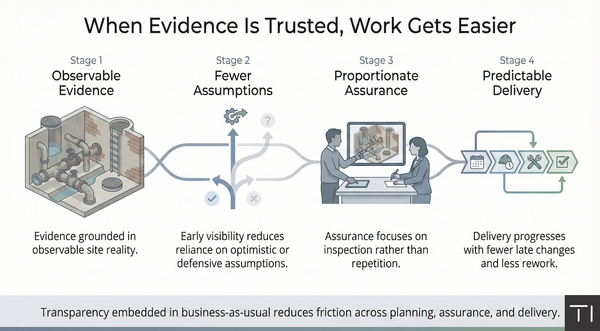
UK water utilities spend a great deal of time discussing cost efficiency, delivery risk, and regulatory compliance. Far less time is spent asking a simpler question: what does it cost when evidence is not trusted? In Drainage and Wastewater Management Plan (DWMP) delivery, lack of trust rarely stops work outright.
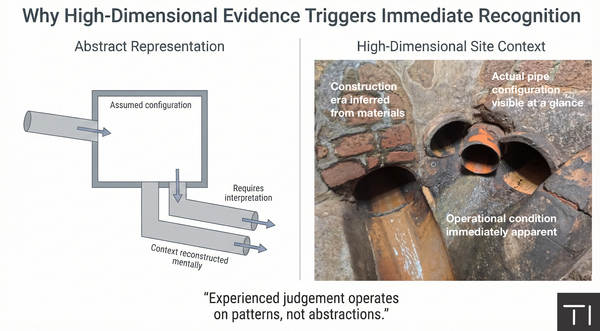
Experienced water industry professionals often make confident judgements very quickly when they are presented with rich site context. They do not work through a checklist or calculate their way to a conclusion. They recognise patterns. This is not intuition in the casual sense, but the result of years spent seeing
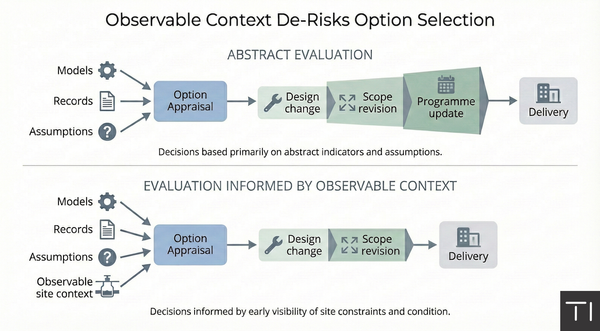
In many infrastructure programmes, delivery risk appears to emerge late. Scope changes surface during detailed design, costs increase during construction planning, and schedules slip as constraints become clearer. These outcomes are often treated as unfortunate but unavoidable. In practice, they are frequently the result of decisions made much earlier, when
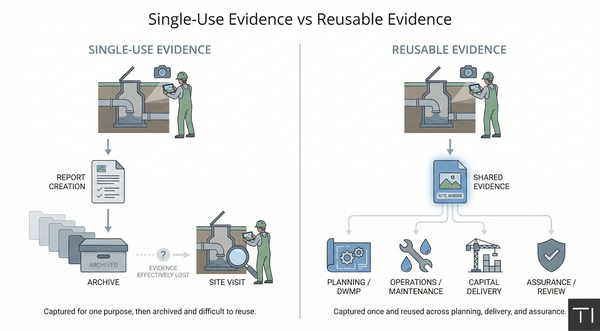
In many operational workflows, site evidence is captured to answer a specific question and then effectively forgotten. Photographs are taken to support a work order, notes are recorded during an inspection, and reports are produced to satisfy a particular review. Once that immediate need has passed, the evidence is archived,
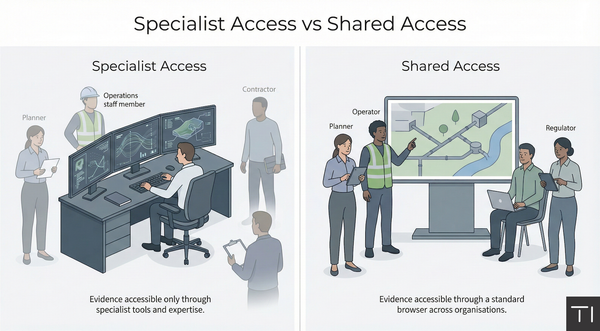
DWMP (Drainage and Wastewater Management Plan) delivery rarely sits within a single team or organisation. Evidence moves between planners developing options, operators managing day-to-day assets, contractors preparing scopes, and regulators reviewing assumptions and outcomes. For decisions to progress with confidence, that evidence must be accessible across these boundaries.

In the context of Drainage and Wastewater Management Plan (DWMP) delivery, assurance is often described in terms of process. Were the right steps followed, the correct templates used, and the required reviews completed. These questions still matter, but they are no longer sufficient on their own. As regulatory scrutiny increases,

Across UK water organisations, repeat site access has become a routine way of closing evidence gaps. When questions arise about access, condition, routing, or clearance, the safest response is often to plan another visit. This is understandable. Site access provides certainty in situations where records and reports leave too much

UK water utilities operate some of the most mature digital estates in the infrastructure sector. Geographic information systems, asset management platforms, enterprise resource planning tools, document repositories, and data warehouses are widely deployed and deeply embedded. In most organisations, the problem is not the absence of systems. The challenge lies