From Seeing to Fixing: The Two Gaps Water Companies Can No Longer Carry
Water companies face two connected gaps: seeing what is really inside their assets, and turning what they find into governed, prioritised action.
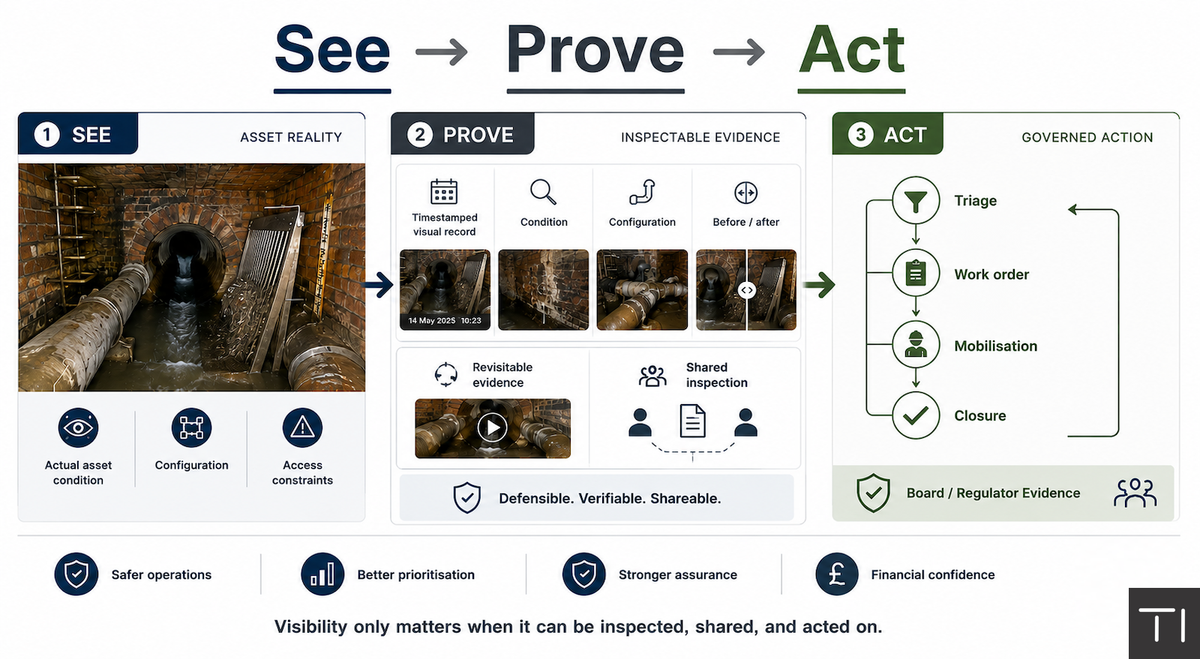
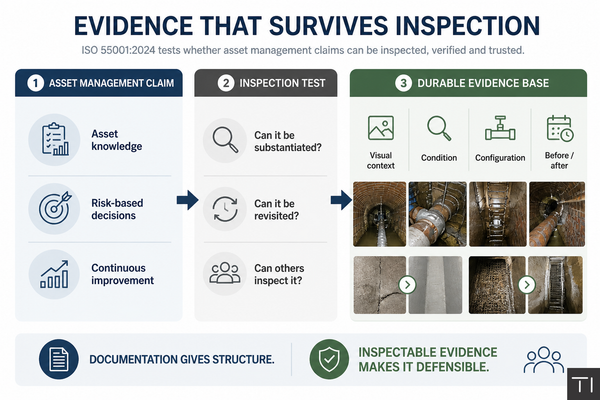
Water and wastewater companies are being asked a harder question than they were a few years ago. It is no longer enough to show that performance was reported, incidents were logged, or action plans were produced after the event. The question now is whether the company had a reliable way of knowing what was happening inside its assets, deciding what mattered, and getting the right work done before a defect became a spill, breach, compensation event, or enforcement finding. That is difficult to answer well when much of the evidence still starts with assets that are hard to see.
This is where the combined approach of Trace Intercept and VISION Consulting becomes important. Trace Intercept provides trusted visual evidence from underground assets, while VISION Consulting provides the operational framework that helps water companies assess, prioritise and mobilise the right actions from that evidence. Together, the two organisations help bridge the gap between seeing what is happening in critical assets and ensuring the right operational, engineering and governance decisions follow.
A large part of the wastewater network sits underground, inside chambers, wet wells, pumping stations, storm overflows and network nodes that were never designed around modern evidence expectations. Many were recorded in corporate systems through drawings, schematics, condition grades and log entries produced under difficult conditions. Those records are not useless; they are often the only reason work can be planned at all. But they do not always show what is actually inside the chamber, and the risk sits in that gap between what the system says and what the asset contains.
A chamber may be recorded as having a certain arrangement of pipes, while the real configuration includes unmapped connections. A screen may be listed as present and serviceable, while the actual screen is damaged, missing, or obstructed. Sensors may be tangled, infiltration may be obvious from staining and flow marks, and a pumping station may have constraints that are invisible from the surface but clear once the inside can be seen properly. These are not signs of carelessness. They are the result of inspection methods built around what was practical at the time, with people making the best judgement they could from what could be seen safely.
The regulatory environment is becoming less tolerant of thin evidence. As supervision becomes more asset-specific and engineering-informed, companies will need to show not just that they reported performance, but that they had a credible system for understanding asset condition, validating what was found, escalating risk, and acting on it. Evidence that only exists as a report, spreadsheet entry, or individual recollection will become harder to defend. Seeing more clearly matters, but seeing alone does not fix the job.
The second gap is the gap between finding a problem and getting it resolved. Many water companies know the pattern well. An operative sees something wrong, a defect is logged, a risk is noted, and the issue moves into a queue. Other priorities intervene, the budget route is unclear, the right function is not engaged, or the work is not scoped tightly enough to proceed. The issue stays open for longer than anyone intended, and what began as an operational finding becomes an asset governance problem.
If a damaged CSO screen is seen but does not become a prioritised work order, the organisation has not closed the risk. If Asset Management cannot see whether the proposed repair fits the longer-term asset plan, the intervention may solve the immediate defect while creating a future planning problem. If Finance cannot see the before-state, intervention scope and after-state, the treatment of spend becomes harder to support. If Regulatory Affairs cannot show the evidence chain, proactive stewardship becomes difficult to demonstrate. If Health and Safety cannot see whether confined space entry is genuinely needed, avoidable exposure remains in the system.
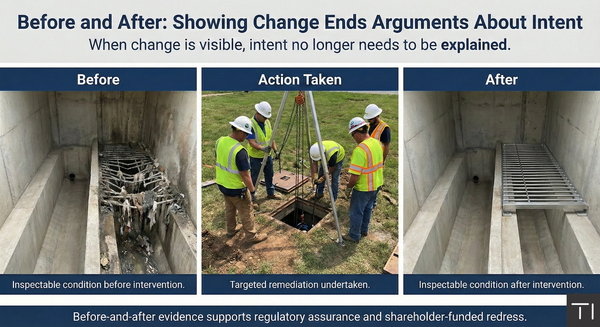
The practical test is whether a defect seen in a chamber becomes a validated risk, a prioritised job, an executed repair, and a before-and-after record that can be shown later. That requires evidence to remain useful beyond the team that captured it. The same visual record needs to support Operations, Asset Management, Finance, Regulatory Affairs, Health and Safety and board oversight. Not as a summary of a summary, but as inspectable asset evidence that different functions can use for their own decisions.
Closing these gaps requires more than better inspection technology. It requires an operating model that connects evidence with decision-making, governance and delivery. This is where Trace Intercept and VISION Consulting work together, combining trusted asset visibility with a structured operational framework that enables effective triage, escalation, prioritisation and mobilisation. The result is a more joined-up approach that helps organisations move efficiently from identifying issues to resolving them with confidence and a clear evidence trail.
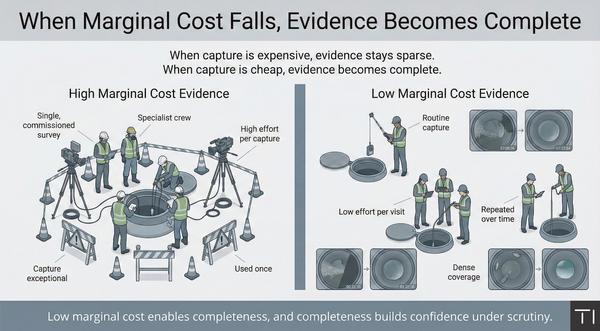
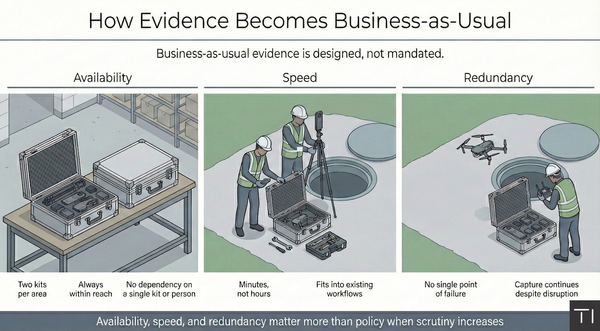
Trace Intercept addresses the first gap by making underground asset condition inspectable through rapid, operator-led 360-degree capture. The output is not a one-off photograph or a condition grade. It is a timestamped, revisitable visual record of the asset that can be viewed by field teams, engineers, asset managers, contractors and executives without immediate confined space entry. VISION Consulting addresses the second gap by defining how evidence turns into action, setting out the operating model for triage, escalation, prioritisation, scheduling and closure. Straightforward repairs can remain close to Operations, while more complex issues bring in Asset Management, Regulatory Affairs, Finance or Health and Safety at the right threshold.
The value is in connecting the two. Visual evidence without mobilisation can still become another archive. Mobilisation without credible evidence becomes another meeting about assumptions. What is needed is a closed loop in ordinary operational language: see the asset, validate the issue, decide who needs to be involved, prioritise the work, mobilise with scope confirmed, and close the record with before-and-after evidence. That loop matters more as regulation moves toward more transparent, asset-level and independently verifiable evidence.
Water companies are going to have to future-proof themselves against a world in which asset management competency, evidence quality and board line of sight are tested more directly. This is not about adding bureaucracy to operations. It is about reducing the work created by uncertainty. Crews mobilise with a clearer scope, designers work from what is there rather than what the drawing implies, Finance can see what spend changed, Regulatory Affairs can show evidence before being asked for it, and boards can challenge management with a clearer view of physical reality.
Read the full VISION Consulting+Trace Intercept article:
The practical question for water companies is where the organisation still depends on what it thinks is true, rather than what it can inspect and prove. If those assets sit inside an AMP8 remediation plan, a storm overflow programme, a pollution reduction plan or a board-visible risk register, they are the right place to start.
Ask us for a short working session on where visibility gaps and mobilisation gaps are most likely to appear in your current wastewater programme.