Why DWMP Decisions Still Depend on Site Visits
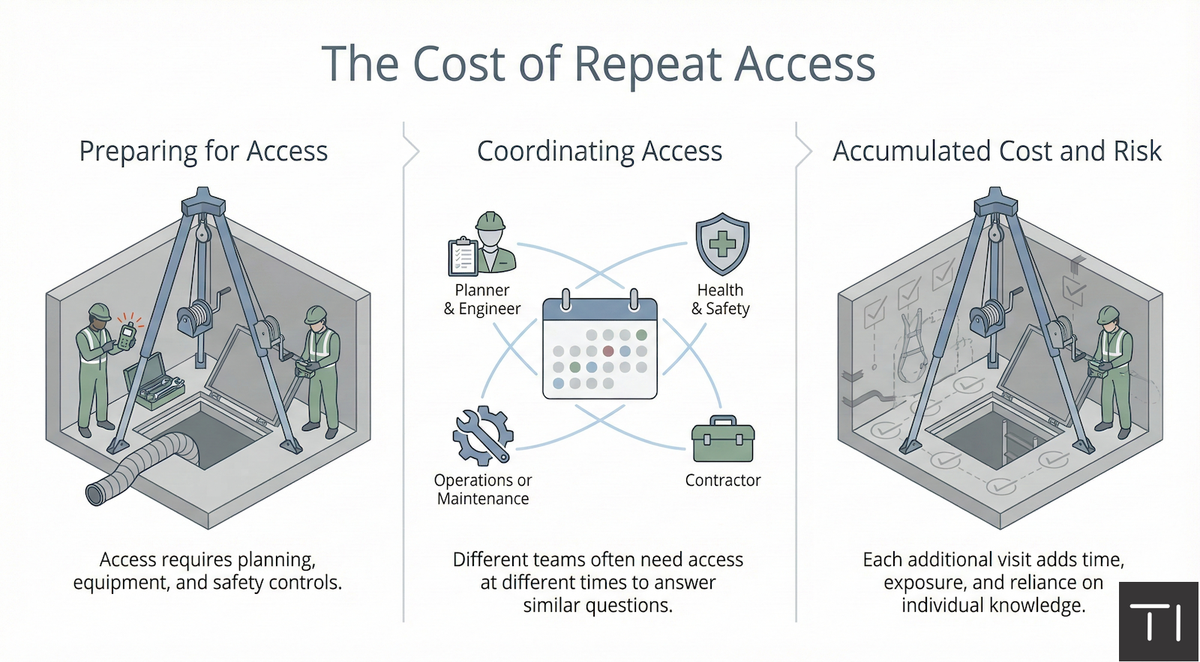
Drainage and Wastewater Management Plans are built on increasingly sophisticated foundations. Hydraulic models are more detailed, asset registers more complete, and analytical tooling more capable than at any point in the past. Yet when decisions move from the abstract to the practical, many teams still find themselves asking the same question: who needs to go and look?
This reliance on site visits is not a sign of poor planning or weak systems. It is a rational response to uncertainty. DWMP decisions ultimately resolve into physical choices about what can be accessed, what can be routed, what condition assets are actually in, and whether there is enough clearance to do the work safely. These questions cannot be answered conclusively from models or records alone.
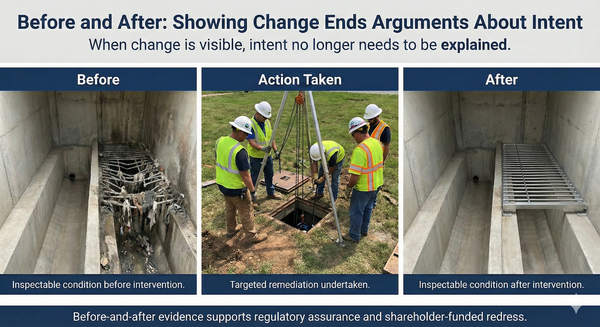
Most systems of record are designed to describe assets, not to show how they exist in space. A GIS feature can indicate where a chamber is located, but not how it is arranged internally. An asset register can list a pump, but not whether it can be removed without temporary works. A work history can show that maintenance has been carried out, but not whether corrosion, debris, or access constraints have changed since the last visit.
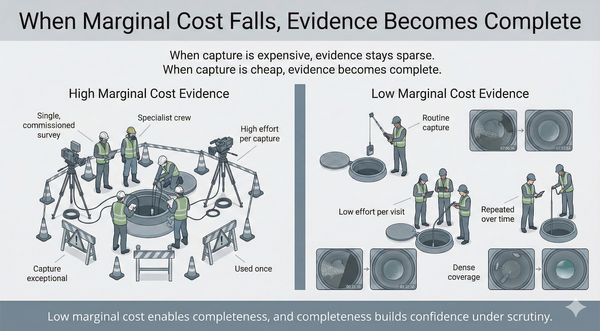
Drawings and photographs are often used to bridge this gap, but they introduce their own limitations. Drawings may be out of date or reflect design intent rather than as-built reality. Photographs are usually captured for a specific purpose, from a specific angle, and then stored in ways that make them difficult to find or reuse. Over time, collections of images become fragmented and ambiguous, leaving as many questions as answers.
In this context, site visits become the default risk-reduction mechanism. When assumptions matter, the safest option is to send someone to confirm them. This is especially true when decisions carry regulatory, safety, or cost implications. Seeing the asset directly provides confidence that cannot easily be substituted by secondary evidence.
However, this dependence on site visits creates its own set of challenges. Access must be planned and coordinated, often around operational windows and safety requirements. Multiple teams may need to visit the same site at different times to answer similar questions. Knowledge accumulates with individuals who have seen the site before, making decision-making more fragile when those individuals are unavailable. In constrained environments, such as confined spaces, each additional visit also carries incremental risk.
The result is a pattern of friction and delay that is familiar across the industry. Decisions pause while access is arranged. Options are narrowed or deferred because uncertainty remains. Evidence is gathered repeatedly rather than reused. None of this is caused by a lack of data. In many cases, organisations are data-rich but context-poor.
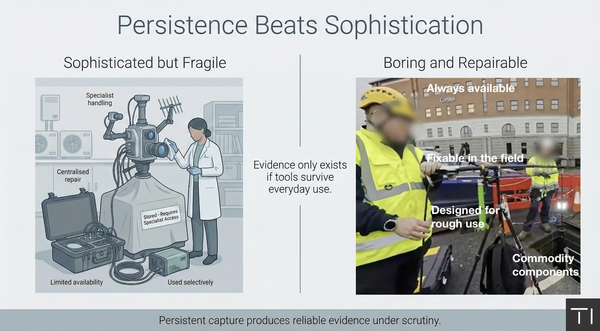
What is missing is shared, observable context that can be accessed without returning to site. Without a way to see and understand how assets actually exist in the field, teams are forced to choose between making decisions on incomplete information or incurring the cost and risk of another visit. Faced with that choice, it is entirely reasonable that site visits continue to dominate.
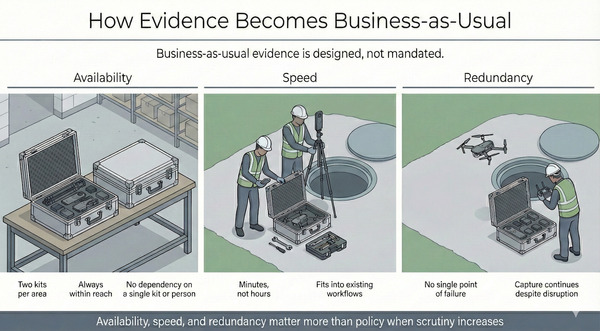
The challenge for DWMP delivery is therefore not to replace site visits entirely, but to reduce unnecessary ones. Early access to reliable, reusable views of operational reality allows teams to resolve basic questions sooner, narrow uncertainties before access is planned, and reserve physical visits for the points where they are genuinely needed. When that context is available upfront, decisions can move faster and with greater confidence, long before downstream optimisation or integration becomes relevant.
Until shared access to reality improves, site visits will remain central to DWMP decision-making. They are not a failure of digital ambition, but a practical response to the limits of how information about physical assets is currently captured and shared.