Why Cheap Evidence Is Often the Most Valuable Evidence
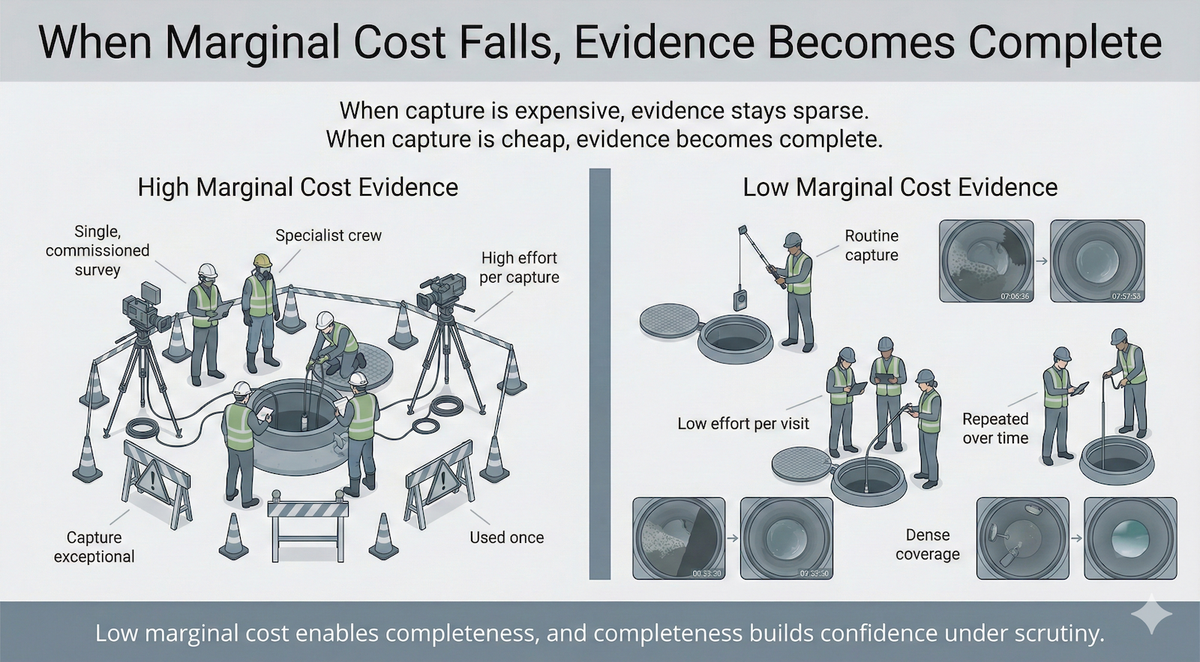
In regulated infrastructure, the conversation about evidence quality often starts with cost. Surveys are expensive. Specialist inspections require coordination. High-end systems come with procurement, training, and support overhead. As a result, evidence gathering is treated as something to be minimised, carefully justified, and used sparingly.
This framing misses what actually determines value.
What matters most is not the unit cost of a single piece of evidence, but the marginal cost of capturing one more. When that marginal cost is high, evidence remains scarce. When it collapses, behaviour changes.
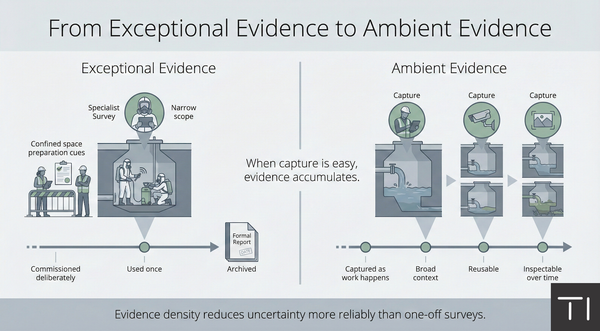
High-cost evidence encourages selectivity. Decisions are made about which sites justify inspection, which questions are worth answering, and which uncertainties can be tolerated. Evidence is commissioned to confirm assumptions, not to challenge them. Gaps are accepted because closing them would be disproportionate. Under scrutiny, those gaps resurface.
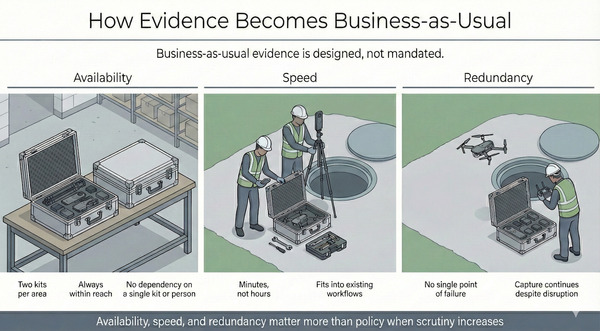
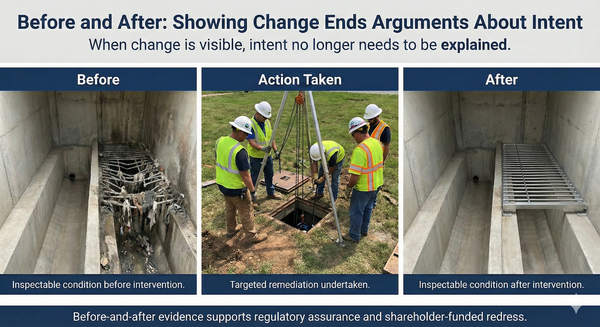
Low-cost evidence behaves differently. When capture is inexpensive, quick, and routine, it becomes complete rather than selective. Before-and-after states are captured without debate. Edge cases are recorded rather than explained away. Evidence accumulates across time and across teams, not just around major interventions.
This completeness is where value emerges.
Under regulatory supervision that is moving away from self-reported assurance toward inspectable, asset-level evidence, confidence depends on what can be shown when questions arise. Complete evidence bases answer questions that were not anticipated at the time of capture. Sparse evidence bases do not. The difference is not analytical sophistication, but coverage.
Low marginal cost also changes organisational behaviour. When capturing evidence does not feel like an event, it is no longer postponed or avoided. Field teams capture because it is easier to do so than not. Engineers work with evidence that already exists. Managers rely on current context rather than historic summaries. Over time, this produces a shared understanding that is difficult to replicate through episodic inspection.
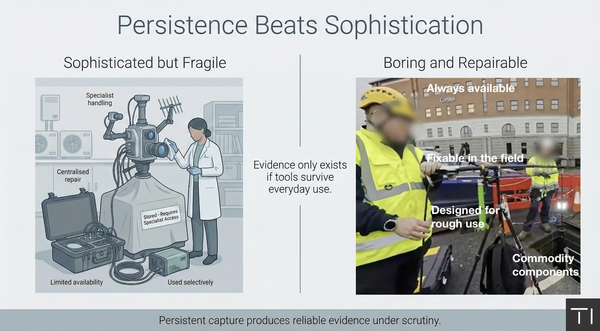
This is why cheap evidence is often more valuable than expensive evidence. Expensive evidence tends to be perfect in isolation and fragile in aggregate. Cheap evidence tends to be imperfect in isolation and robust in aggregate. Under scrutiny, robustness matters more than precision.
The regulatory implications are becoming clearer. As oversight shifts toward earlier intervention and asset-specific supervision, evidence that exists before it is asked for carries disproportionate weight. It reduces the need for explanation, justification, and defensive contingency. It shortens challenge cycles and narrows uncertainty. Those effects translate directly into reduced friction, fewer delays, and more defensible decisions.
The same logic applies to capital efficiency and shareholder exposure. Where evidence is incomplete, uncertainty is priced in through conservative assumptions and buffers. Where evidence is complete, uncertainty is bounded. The cost of capturing that completeness is often far lower than the cost of carrying the uncertainty it removes.
None of this suggests that specialist surveys or high-precision inspection lose their place. They remain essential where precision is required. The point is that they deliver far more value when they sit on top of a dense, ambient evidence base rather than being asked to discover basic facts under pressure.
As regulatory expectations continue to evolve, practices built around selective, high-cost evidence will struggle to age well. Practices that make capture cheap enough to be routine will not. Low cost enables completeness, and completeness enables confidence. In the current environment, that confidence is what evidence is really for.