How Evidence Becomes Business-as-Usual
In many organisations, evidence programmes fail not because of policy gaps, but because of friction. Expectations are set, procedures are written, and capture is encouraged, yet evidence remains sporadic. Under scrutiny, the absence of evidence is explained as an exception. Over time, those exceptions accumulate.
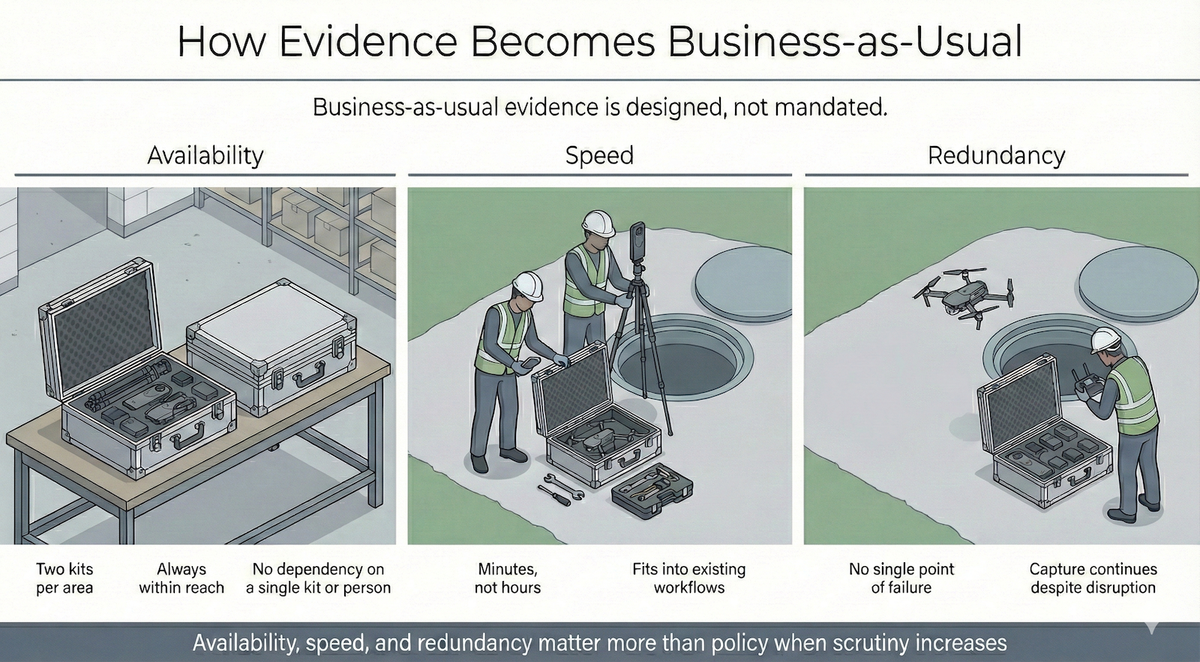
What determines whether evidence becomes business-as-usual is not intent or governance alone. It is availability, speed, and redundancy. When evidence can be captured easily, quickly, and without coordination, it happens. When it requires planning, permission, or specialist availability, it does not.
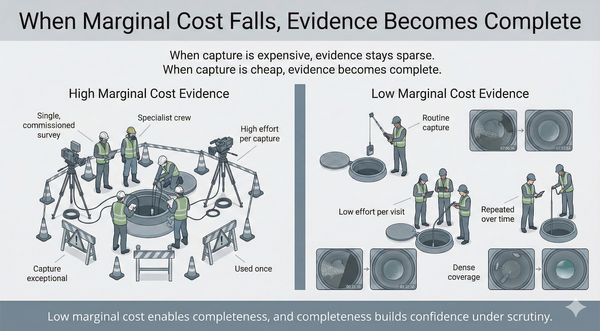
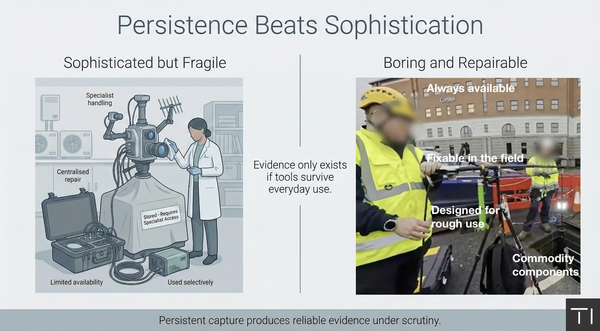
Availability is the first constraint. If capture depends on a single kit, a named individual, or a scheduled activity, it will be missed. The moment evidence becomes scarce, it becomes precious, and precious things are handled carefully and infrequently. By contrast, when capture tools are always within reach, evidence gathering becomes unremarkable. It is done because there is no reason not to.
Speed matters for the same reason. Evidence that takes minutes to collect fits into existing workflows. Evidence that takes hours competes with operational priorities. Under time pressure, optional steps are dropped. Making capture fast enough to be incidental is what allows it to persist.
Redundancy is the third, and often overlooked, factor. Two or three capture kits per area is not a logistics convenience. It is a governance choice. Redundancy removes bottlenecks, eliminates dependency on a single asset or person, and ensures that evidence capture does not stop when one kit is unavailable. In practice, redundancy is what turns intention into reliability.
This is why adding rules rarely produces better evidence. Policies can mandate capture, but they cannot overcome friction. When capture is hard, compliance becomes selective. When capture is easy, compliance becomes irrelevant because behaviour aligns naturally with expectation.
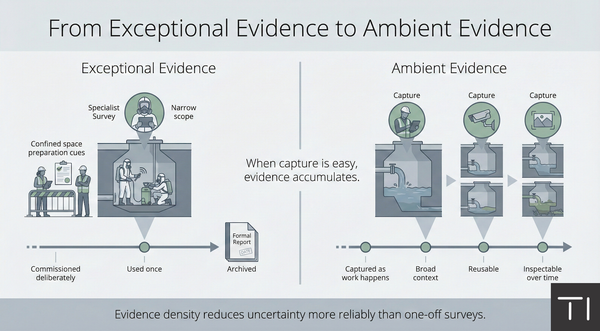
Business-as-usual evidence emerges when capture is embedded into the flow of work rather than layered on top of it. Field teams capture because the tools are there. Engineers use the evidence because it exists. Managers rely on it because it is current. Over time, evidence becomes ambient rather than exceptional.
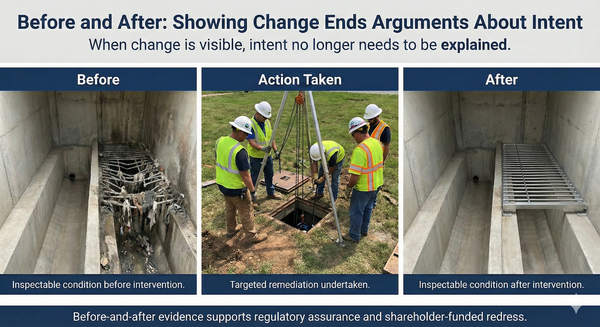
This shift has important governance implications. Evidence that is captured routinely is less vulnerable to challenge because it is not produced reactively. It exists before questions are asked. Under regulatory supervision that is moving toward earlier intervention and asset-specific scrutiny, this timing matters.
The same logic applies to accountability. When evidence is sparse, gaps are explained. When evidence is dense, gaps are obvious and can be addressed. Redundancy ensures that absence of evidence is the exception, not the norm.
None of this requires more policy. It requires fewer points of failure. Availability, speed, and redundancy do more to improve evidence quality than any number of procedural mandates.
As regulatory expectations continue to evolve toward inspectable, asset-level evidence, organisations that design for business-as-usual capture will find themselves better prepared. Evidence that is routine is easier to defend than evidence that is exceptional. Removing friction, rather than adding rules, is what makes that routine possible.