Designing Capability That Works for Planners, Operators, and Regulators
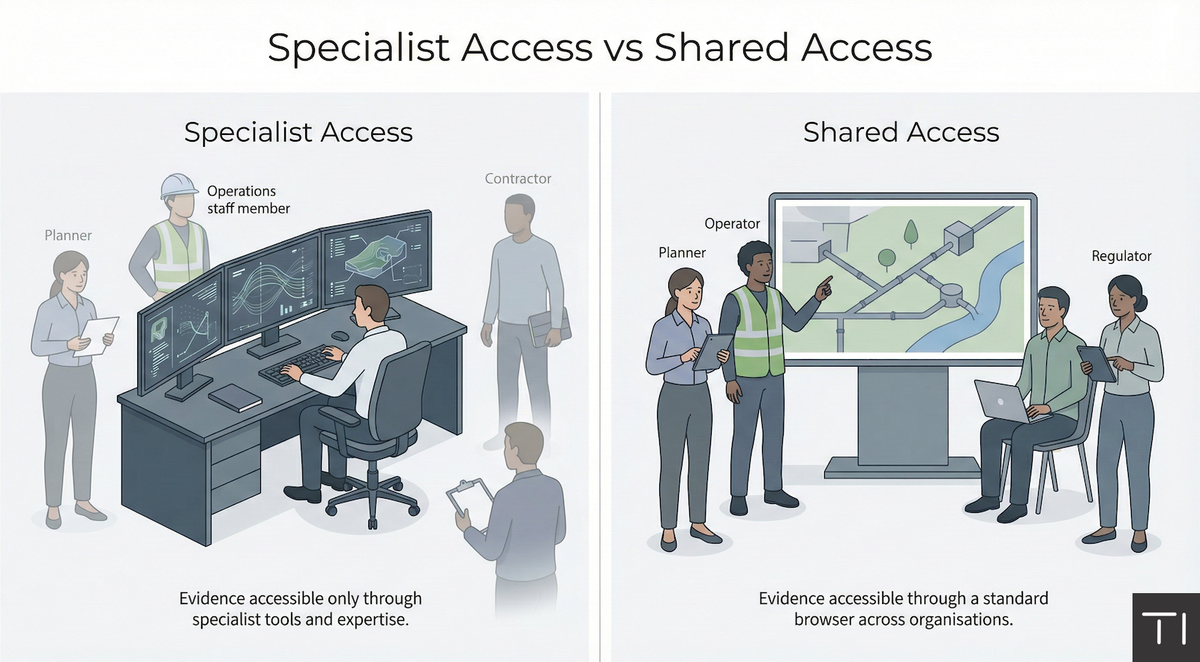
DWMP (Drainage and Wastewater Management Plan) delivery rarely sits within a single team or organisation. Evidence moves between planners developing options, operators managing day-to-day assets, contractors preparing scopes, and regulators reviewing assumptions and outcomes. For decisions to progress with confidence, that evidence must be accessible across these boundaries.
In practice, many tools used to support infrastructure planning and operations are designed for specialist users. They assume dedicated software, training, and licences, and they work well within the teams that own them. The difficulty arises when evidence needs to travel beyond those teams. Each additional barrier to access increases delay, introduces interpretation risk, and limits who can engage directly with the underlying information.
Specialist tools constrain who can see evidence. When access depends on particular software or expertise, most stakeholders receive evidence second-hand, through screenshots, summaries, or reports. Each step away from the source introduces the potential for misinterpretation. Questions that could have been resolved quickly by looking at the same information instead turn into exchanges of emails, revised documents, or additional site visits.
Browser-based access changes this dynamic. When evidence can be viewed through a standard web interface, it becomes available to planners, operators, safety teams, contractors, and regulators alike. There is no need to install software or replicate complex workflows. The evidence itself becomes the shared reference point, rather than an interpretation of it.
Shared visibility reduces reinterpretation risk. When different parties can see the same context, discussions shift from debating what something means to agreeing what it shows. This is particularly important in DWMP delivery, where decisions are often revisited over long timescales and by different audiences. Evidence that remains directly accessible retains its explanatory power as those audiences change.
Accessibility also supports audit and assurance. Regulators and internal reviewers are more likely to accept conclusions when they can inspect the supporting evidence directly, without relying on intermediaries. This does not remove the need for analysis or judgement, but it makes those judgements easier to understand and defend. Evidence that can be accessed easily is also easier to revisit when circumstances change or further questions arise.
Adoption improves when access does not require mandate. Tools that depend on formal rollouts, training programmes, or licence management often struggle to achieve consistent use across organisational boundaries. By contrast, capabilities that can be accessed easily, on demand, tend to be adopted where they add value, without the need for enforcement. This is particularly relevant in environments where multiple organisations, contractors, and regulators need to engage with the same evidence.
From a procurement and governance perspective, these considerations are practical rather than theoretical. Capability must be usable by non-specialists if it is to support DWMP delivery across planning, operations, and assurance. Access models matter as much as technical function, because they determine who can see evidence and when.
Designing for accessibility is therefore not a user-experience preference. It is a delivery requirement. When evidence can be shared easily and consistently across roles and organisations, decisions move faster, assurance becomes more straightforward, and the risk of misinterpretation is reduced.