Before and After: The Simplest Form of Regulatory Defence
In regulatory and assurance contexts, many disputes do not arise because action was not taken, but because it cannot be shown clearly what changed as a result. Intent is asserted, effort is described, and plans are documented, yet confidence remains elusive. Under increasing scrutiny, this pattern has become a liability.
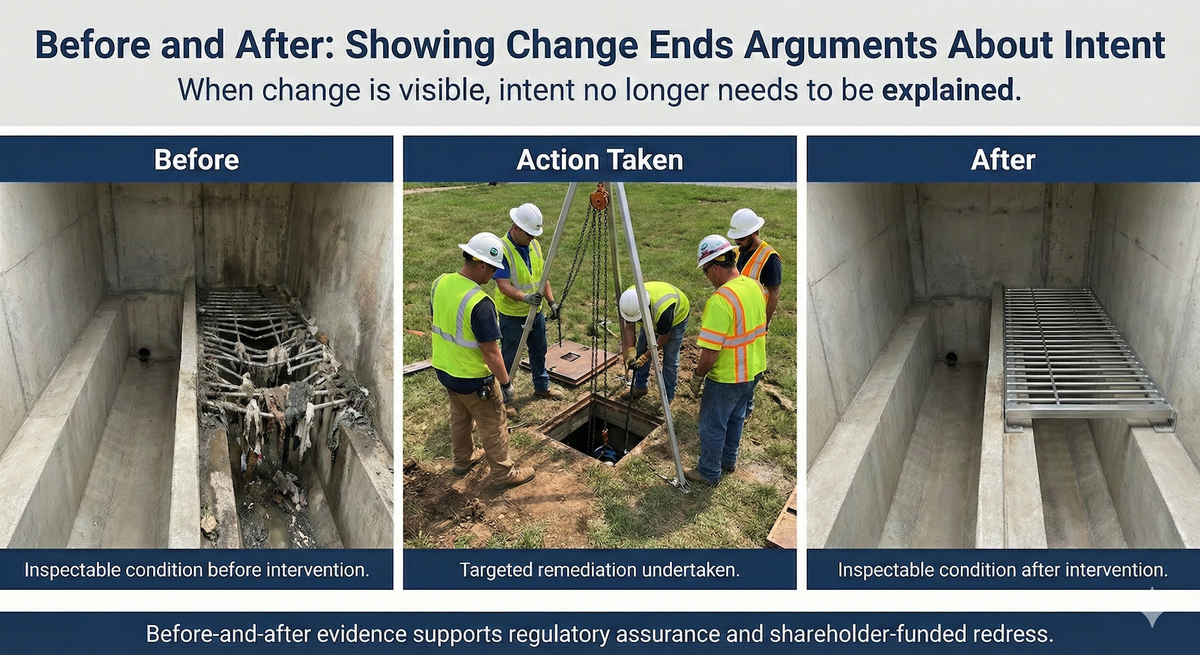
Before-and-after evidence addresses this directly. It is one of the simplest and most durable forms of regulatory defence because it bypasses explanation and focuses on observable change. When an issue is visible before intervention and demonstrably altered afterwards, questions about intent, adequacy, and follow-through tend to fall away.
This matters because Ofwat’s recent enforcement activity has made clear that narrative assurances are no longer sufficient. Regulators are moving away from self-reported compliance toward inspectable, asset-level evidence. In that environment, the ability to show what existed, what was done, and what now exists carries more weight than detailed descriptions of process.
Before-and-after capture turns remediation into something verifiable. It anchors decisions in physical reality rather than inference. When the regulator can see the configuration that gave rise to a problem, and then see the configuration after remediation, the discussion shifts from whether the company acted appropriately to whether the change addresses the root cause. That is a far narrower and more productive conversation.
This is also why before-and-after evidence is particularly relevant in the context of shareholder-funded redress. Where remediation is paid for by shareholders rather than customers, boards and investors require confidence that spend is necessary and effective. Being able to demonstrate, visually and unambiguously, what condition existed and how it has been altered provides that confidence. It protects shareholders from funding work whose impact cannot be shown.
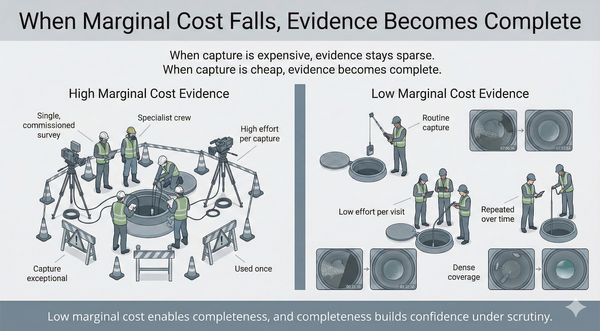
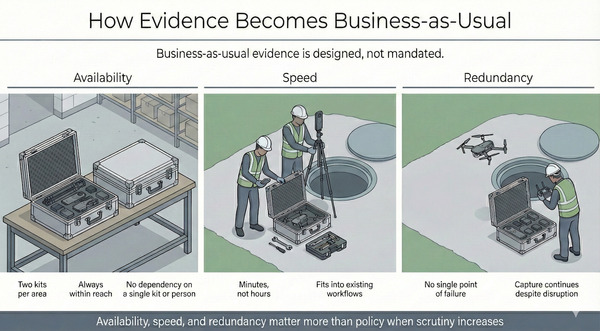
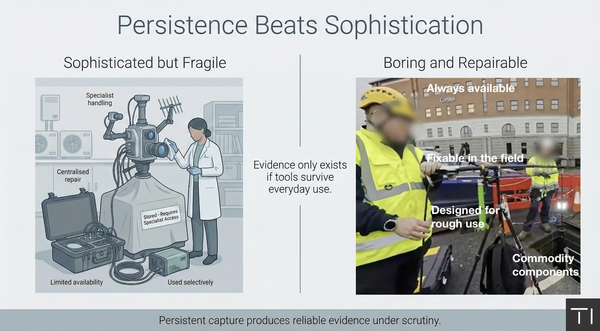
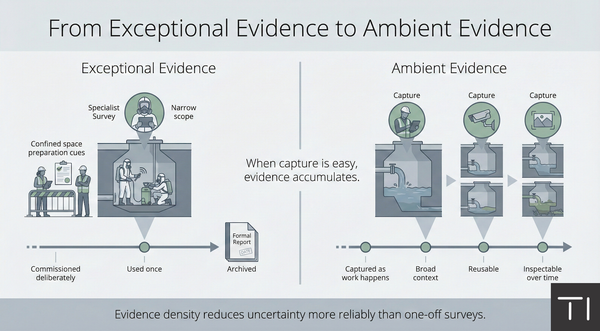
Importantly, before-and-after evidence does not need to be elaborate to be effective. Its power lies in its clarity and persistence. A consistent visual record captured as part of routine work allows conditions to be revisited later, by different audiences, without relying on memory or interpretation. This supports both immediate assurance and future scrutiny.
The governance value becomes clear when timelines stretch. Remediation decisions made today may be reviewed months or years later, under different regulatory expectations or ownership structures. Evidence that only exists as a summary or a report degrades over time. Evidence that shows change endures. It allows reviewers to see what was known at the time and what was actually altered.
There is also a practical benefit under enforcement conditions. When regulators are intervening earlier and more frequently, the volume of challenge increases. Each challenge consumes time and organisational capacity. Before-and-after evidence shortens these cycles. It reduces the need for supplementary explanation and repeat inspection because the core question has already been answered visually.
None of this implies that before-and-after capture replaces inspection, analysis, or engineering judgement. It complements them. It provides a common reference point that aligns operators, boards, regulators, and investors around the same observable facts. When those facts are clear, debates about motivation and adequacy tend to resolve quickly.
As regulatory expectations continue to evolve toward more asset-specific, engineering-informed supervision, evidence that demonstrates change rather than intention will age better than narrative assurances. Practices that make before-and-after capture routine, rather than exceptional, are therefore not just operationally efficient. They are a form of future-proofing.
Showing change does not guarantee approval. It does, however, end arguments about whether action was taken and focuses scrutiny where it belongs. In the current regulatory environment, that shift alone has material value.