A Shared View of Reality: Reducing Repeat Access Without Replacing Systems
Across UK water organisations, repeat site access has become a routine way of closing evidence gaps. When questions arise about access, condition, routing, or clearance, the safest response is often to plan another visit. This is understandable. Site access provides certainty in situations where records and reports leave too much open to interpretation.
However, site access is expensive, constrained, and carries risk. It requires coordination across operations, safety, and contractors. In confined environments, it also introduces exposure that teams work hard to minimise. When the same sites are visited multiple times by different teams to answer similar questions, the cost is not just financial. It accumulates in delay, scheduling friction, and reliance on individual knowledge.
The pattern is familiar. Planners need to confirm whether an option is feasible. Maintenance teams want to understand access before scoping work. Safety teams need clarity on entry conditions. Capital delivery teams revisit the same assets later to validate assumptions. Each group approaches the site with a slightly different question, often months apart, and often without access to what others have already seen.
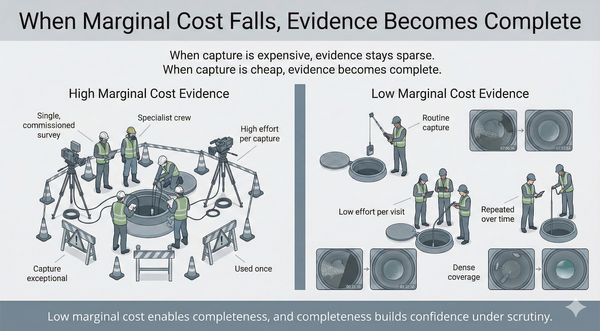
This duplication is not caused by poor coordination. It is a consequence of how site information is captured and shared. Photographs are usually taken for a specific task, from limited angles, and stored in ways that make them difficult to reuse. Drawings and records provide structure but not context. As a result, evidence gathered for one purpose rarely answers the next set of questions with sufficient confidence.
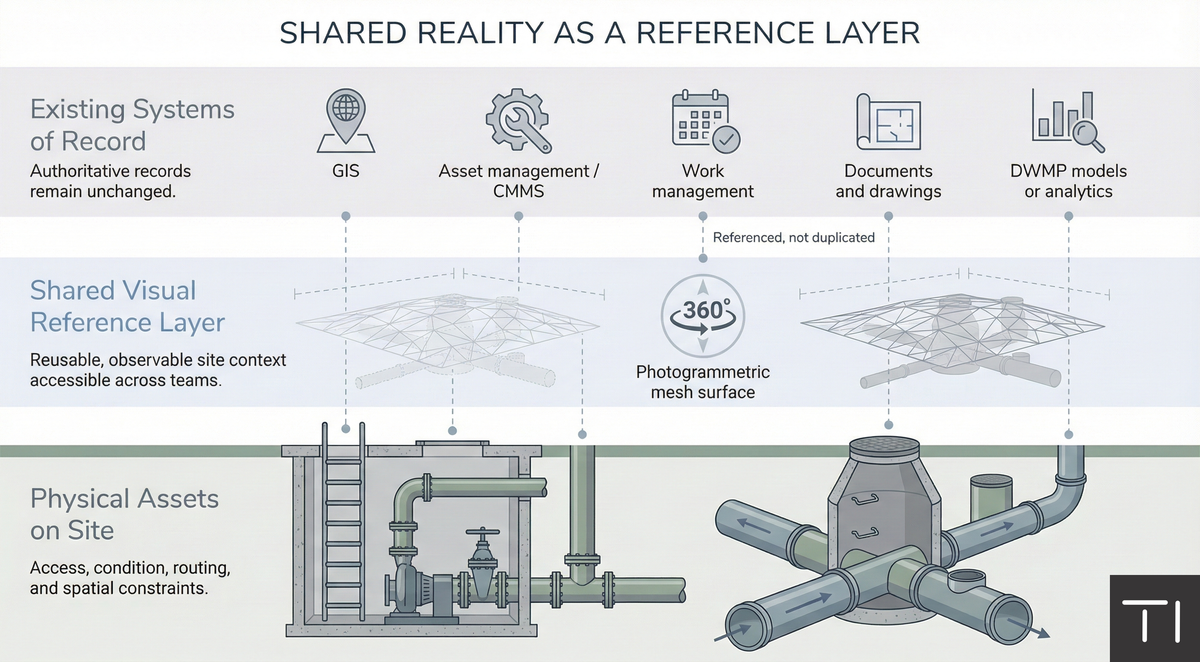
A shared view of reality changes this dynamic. When site conditions are captured in a way that preserves spatial context and can be accessed through a standard web browser, evidence gathered once can be reused many times. Teams are no longer dependent on the original observer being available to explain what was seen. Different functions can interrogate the same site from their own perspective, at the time they need to make a decision.
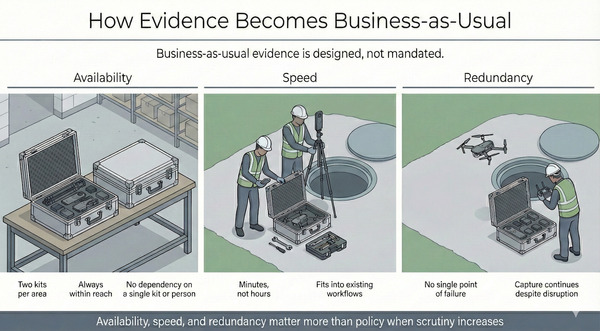
Browser-based access is critical here. It removes the need for specialist software or training and allows planners, engineers, safety staff, contractors, and regulators to view the same evidence. This makes the evidence itself the shared reference point, rather than a summary or interpretation passed between teams.
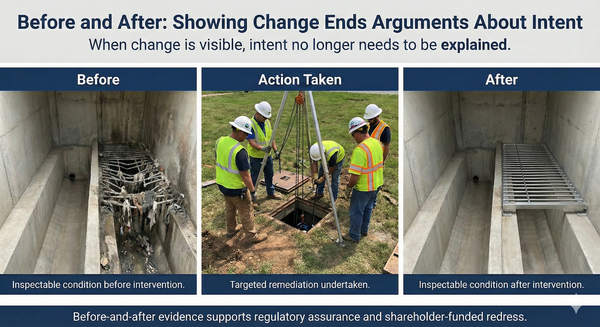
Measured visual context adds an additional layer of value. Being able to see how assets are arranged, how space is constrained, and how condition presents in situ supports both planning and assurance. It allows teams to resolve practical questions earlier and reduces the likelihood that assumptions will need to be revisited through another site visit.
Importantly, this approach does not require replacing existing systems. GIS platforms, asset management systems, work management tools, and document repositories remain authoritative for their respective records. The shared reality view sits alongside them. Stable links connect records to observable site evidence without duplicating data or introducing early integration overhead.
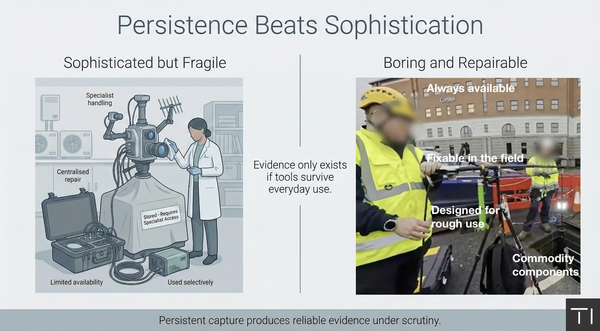
Trace Intercept provides this shared reality view as a practical, browser-based product. It enables teams to capture site conditions using accessible capture methods and to access measured visual context through a standard web interface. The intent is not to create another system of record, but to provide a reusable reference layer that connects existing records to what actually exists on site.
From a delivery perspective, the benefits are cumulative. Fewer unnecessary site visits are required to answer basic questions. Access can be reserved for the points where physical intervention is genuinely needed. Evidence gathered early in a planning cycle remains useful as decisions progress toward delivery and assurance.
From a governance and procurement perspective, the implications are equally important. Capability needs to be usable by non-specialists to ensure broad adoption. Evidence should be reusable across functions, not tied to a single workflow or team. Systems should remain independent, preserving flexibility and avoiding lock-in.
A shared view of reality does not eliminate the need for site visits. It makes them more deliberate. By giving teams earlier access to reliable, reusable evidence, it reduces repeat access driven by uncertainty and allows existing systems to do what they already do well, grounded in a clearer understanding of the physical world they represent.